Our College Profile
Discover what Catholic Junior College stands for — its mission, programmes, and academic offerings that shape students into thinkers and leaders.
Our College Profile

Catholic Junior College School Profile
Catholic Junior College
129 Whitley Road, Singapore 297822, Republic of Singapore Tel: (65) 62524083 – Fax: (65) 62537267
Website: https://cjc.moe.edu.sg (opens in new tab) CEEB Code: 687204
Overview
Catholic Junior College (CJC) is a co-educational government-aided school for post- secondary education at pre-university level. Students are admitted to the school through the national Joint Admissions Exercise (JAE) which takes place in January each year. Students are admitted to CJC based on the cumulative points achieved at the national GCE O-Level Examination. The basis of admission is selective based on merit.
At the end of the two years, students sit for the GCE A-Level examination. Thereafter, students who graduate from the college will go on to attend reputable universities both locally and abroad.
Each year, CJC sees a graduating cohort of about 700 to 750 students, and is recognised as a distinctive college with high levels of achievement and a place of excellence in learning and living.
History
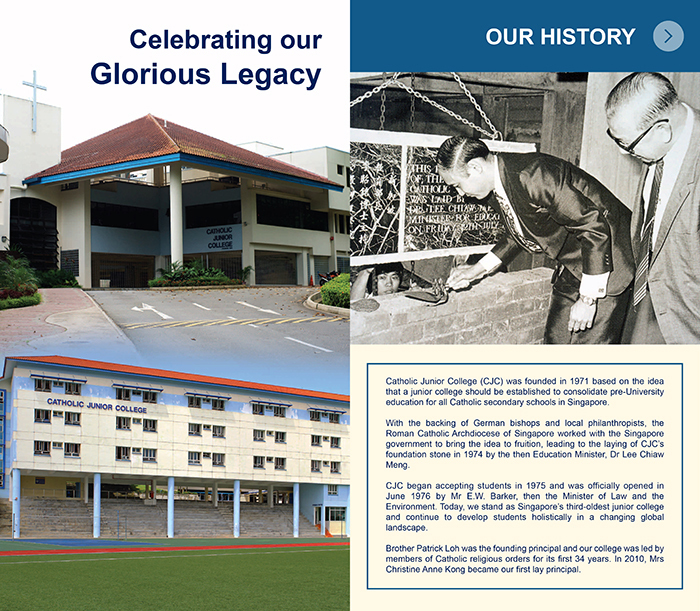
CJC was founded in 1971 on the idea that a junior college should be established to provide holistic pre-university education for all Catholic secondary schools in Singapore. With the backing of local philanthropists, the Roman Catholic Archdiocese of Singapore worked with the Singapore government to bring the idea to fruition, leading to the laying of CJC’s foundation stone in 1974 by the then Education Minister, Dr. Lee Chiaw Meng.
CJC began accepting students in 1975 and was officially opened in June 1976 by Mr. E.W. Barker, then the Minister of Law and the Environment. Today, we stand as Singapore’s third oldest Junior College and continue to develop students holistically as ‘Thinkers with a Mission and Leaders with a Heart’ in a changing global landscape.
Vision
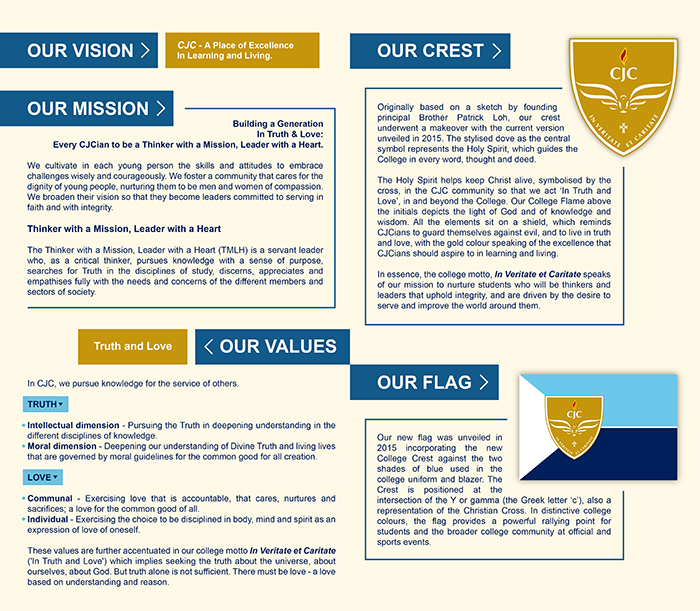
CJC - A Place of Excellence in Learning and Living
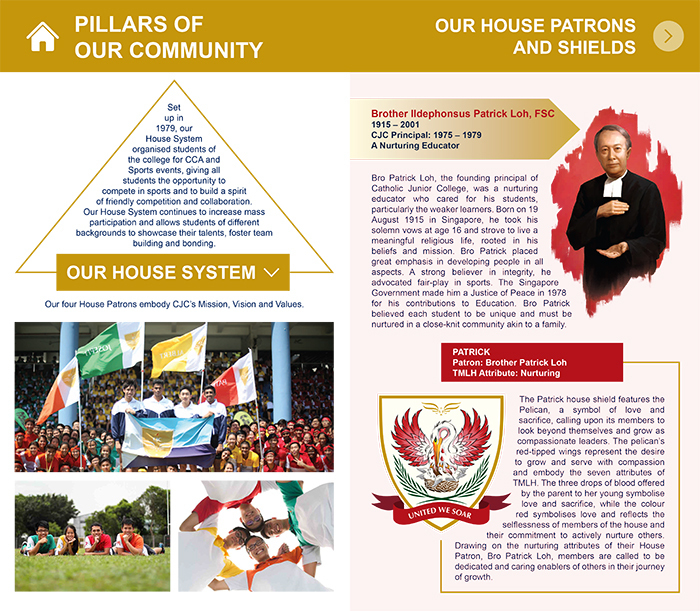
Brother Patrick Loh, the founding principal of Catholic Junior College, envisioned that "underlying education is the concept of the unique, irreplaceable value of every human person. Our education should therefore help each person to understand himself as he truly is, to fulfill their special vocation in life."
Over the years CJC continues to bring this vision to life, as a place of excellence in learning and living. As an educational institution, CJC strives for high standards in educating young people thereby enabling students to realise their potential academically, physically and spiritually so that our students are formed to be well-integrated into society.
1. Student Outcomes: Every CJCian to be a Thinker with a Mission, Leader with a Heart
At CJC, we nurture every student to become a purposeful, disciplined learner guided by strong values like humility, courage, and integrity. Our students grow into critical and adaptive thinkers and effective communicators, striving for veracity and justice when forming meaningful collaborations. They are also servant leaders, ready to serve others and make a positive impact in their communities.
2. Staff Outcomes: Our staff nurture the holistic development of students and embody the values of being Reflective, Innovative, Caring, and Engaged, striving always for excellence.
Our team of dedicated staff support the academic, physical, and spiritual growth of every student. Our staff embody servant leadership, continuous learning, and collaboration to create a vibrant, caring community focussed on developing student agency.
3. Culture Outcomes: A college culture grounded in Truth and Love — expressed through Respect, Solidarity, Service, and Excellence
We envision a college culture deeply grounded in the values of truth and love, where respect, solidarity, service, and excellence flourish. We inspire everyone to honour their God-given dignity and unique gifts, grow in character, and pursue their calling with passion — building a compassionate community that contributes meaningfully to the world.
Mission
Building a Generation in Truth and Love: Every CJCian to be a Thinker with a Mission and a Leader with a Heart.
At Catholic Junior College, our mission reflects our commitment to nurturing young men and women holistically. Rooted in the Catholic tradition, this mission calls every CJCian to pursue the truth and embody love in their every action. It is grounded in five foundational marks:
Holistic Education- We guide students beyond academic excellence, it develops the whole person to fulfil their unique purpose in the world.
Human Dignity- We value the dignity of every person, nurturing each individual to their fullest potential and fostering respect for all.
Common Good- We exhort students to connect knowledge with values and pursue truth for the common good.
Solidarity- We seek to cultivate relationships grounded in trust, respect, and a common purpose, nurturing a spirit of solidarity.
Servant Leadership- We reflect servant leadership by living out values of humility, compassion, and love.
Values
At CJC, our mission is deeply rooted in the universal values of truth and love, which are inspired by the life of Christ.
Truth
Intellectual dimension- Pursuing the Truth in deepening understanding in the different disciplines of knowledge.
Moral dimension- Deepening our understanding of the Divine Truth and living lives that are governed by moral guidelines such as the Dignity of the Human Person, the Common Good, the Principle of Solidarity and the Universal Destination of Goods and Subsidiarity.
Love
Communal - Exercising love that is accountable, that cares, nurtures and sacrifices; a love for the common good of all.
Individual- Exercising the choice to be disciplined in body, mind and spirit as an expression of love of oneself.
Truth and Love: Complementary in Action
Truth and love are inseparable and must be lived together. Truth guides us in understanding who we are and what we are called to do, while love animates us in ways that honour that truth. "Speaking the truth in love, we will grow to become in every respect the mature body of Him who is the head, that is, Christ" (Ephesians 4:15).
Without truth, love becomes misguided. Without love, truth becomes cold and impersonal. Together, they form the foundation for a life that is not only intellectually sound but also morally and spiritually whole. This integration of truth and love is the core of our mission at CJC.
Student Outcomes: Thinker with a Mission, Leader with a Heart
The school’s mission is to develop every CJCian to be a Thinker with a Mission, and Leader with a Heart - a servant leader who, as a critical-thinker, pursues knowledge with a sense of purpose, searches for Truth in the disciplines of study, discerns, appreciates and empathises fully with the needs and concerns of the different members and sectors of society.
Key Student Development Programmes
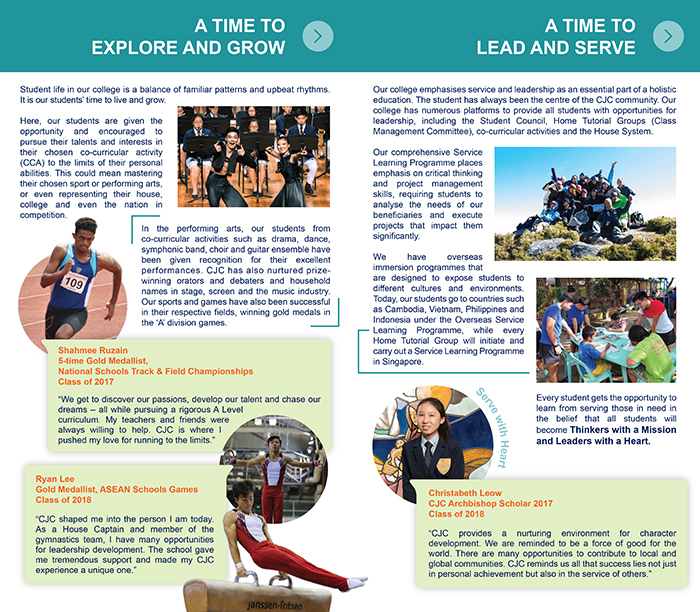
CJC’s Student Development programme is based on enacting social change, starting from the SELF, learning to work and inspire a TEAM towards the benefit of the larger COMMUNITY. Every students is required to take ownership in developing his or her leadership potential, with a focus on translating core leadership principles to serve others and enact positive change both locally and overseas.
Local Leadership Programmes:
(a) Local Service Learning Programme (LSLP)
Service-learning at CJC is grounded in the Catholic ethos of upholding human dignity, acting in solidarity with those who face challenges, and working for the common good. Students exercise values-based agency in choosing how they participate in service, progressing through increasingly immersive tiers — from indirect support to direct interaction with beneficiaries — and culminating in student-led Local Service-Learning Projects (LSLPs). To support this journey, our annual Service-Learning Fair allows students to connect with community partners and identify suitable Values in Action (VIA) and LSLP opportunities aligned with their personal mission and interests. The PW@CJC Social Impact Programme further strengthens this growth by integrating LSLPs with the A-Level Project Work (PW) curriculum, providing every class with a platform to design and implement feasible projects that create positive social impact.
(b) Work Attachment and Shadowing Programme (WASP)
The CJC WASP aims to help students’ transition from school to further education and work. It enables students to apply their knowledge, skills and values in different work context, thus improving their capacity to manage their educational and career pathways. Based on WASP, students spend two to three weeks on a work attachment whereby they come to see the importance of their future university and career choices and are inspired to make a positive difference. They are also guided through a deliberate process of reflections, which is further supplemented by lessons that help them to see their role in Singapore’s future, and how their actions have a wider impact on others.
Global Leadership Programmes
Overseas Service Learning Programmes (OSLP)
A signature global leadership development programme which enables JC1 students to participate in overseas Service Learning trips to countries such as Vietnam, Thailand and Cambodia, where they engage and serve local communities. The programme weaves reflective practice, peer learning, decision- making processes, exploration and investigation to complement the college's mission, building a generation of students with the mission to lead and serve others and make a positive impact beyond Singapore
Our Co-Curricular Activities
Physical Sports
Badminton ▫ Basketball ▫ Bowling ▫ Canoeing ▫ Cross Country ▫ Fencing ▫ Floorball ▫ Football ▫ Netball ▫ Swimming ▫ Tennis ▫ Ultimate Frisbee ▫ Volleyball
Visual and Performing Arts
Choir ▫ English Drama ▫ Guitar Ensemble ▫ Guzheng Ensemble ▫ Modern Dance ▫ Symphonic Band
Clubs and Societies
Editorial Club ▫ Film Sound Video Society ▫ First Aid Club ▫ Genesis (Second CCA) ▫ Interact Club ▫ Nexus Investment & Entrepreneurship Society ▫ Oratorical Society ▫ STE2M Club ▫ Strategy Games Club ▫ Student Council
Leadership opportunities
Student Council ▫ House Leaders ▫ Class Committees ▫ Subject Leaders
The Singapore-Cambridge A-Level (Advanced Level) Examination Syllabus (revised in 2007)
From 2006, a broader and more flexible A-Level curriculum was adopted in line with the nation’s approach for formal education to be relevant to changing needs both locally and globally.
All students taking the GCE A-Level examinations should be required to study a contrasting subject (from a discipline other than their main course of study), as well as to engage in a project-based activity with their peers. A new three-tiered structure was introduced with H1, H2 and H3 options available – categories sorted by increasing rigour demanded.
All students are required to take a minimum of three subjects at the H2 level and these are equivalent to a full A-Level in the current UK system. In addition, students must sit for one other subject at either H1 or H2 level.
There are two compulsory elements of the two-year course which are referred to as “Knowledge Skills” subjects (see below). These are General Paper, Knowledge and Inquiry and Project Work (completed in the first year).
Students are expected to take a minimum of 10 units (H1: 1 unit; H2: 2 units; H3: 1 unit). Some students may take a more demanding course of up to 12 units. These students would most likely take a fourth H2 subject and possibly a subject at the H3 level.
Academic Calendar
The academic year runs from January to December, comprising two semesters or four terms. Each course of study typically lasts for two years and culminates in students taking the GCE A-Level examinations in November of the graduating year.
Internal examinations are conducted across two years so that students and staff can monitor progress in learning:
JC1 (year 11): Promotional Examination
JC2 (year 12): Preliminary Examination
Estimated or predicted grades are based on the student’s progress across the two years and are sent to universities and college admissions boards if the GCE A-Level examination results are not yet available, due to the differences in college/ academic calendars.
Classes and Course Load
Based on the minimum 10 unit course, classes for each subject are taught through lectures, tutorial sessions and for science subjects, practical sessions. Each class period lasts for 55 minutes, with practical sessions utilising two such periods. In addition to the lecture/tutorial approach, certain classes are conducted using a seminar approach for greater levels of inquiry and interaction. This mode of delivery has been adopted for all Humanities subjects from 2016.
Some students with the interest and aptitude to offer subjects at a higher level are able to offer 1 to 2 H2 subjects at the H3 level. H3 courses are conducted in a variety of ways, depending on each discipline, in collaboration with Institutes of Higher Learning. They are equivalent to the American high school honours courses or the S papers in the UK system. The other common mode of assessment for H3 courses would be through an extended research essay where the research is carried out independently by the student.
Grading system at CJC
A-Level Grading
Grades A-E are considered passing grades whilst grade S Is considered a ‘sub- pass’ - falling below expectation. Grade U (ungraded) is considered a failing grade. The marking divisions are shown below.
A-level grade boundaries and mark allocations at CJC
H1/H2 | A | B | C | D | E | S | U |
H3 | Distinction | Merit | Pass | Sub | Ungraded | ||
Mark allocation | 70-100 | 60-69 | 55- | 50- | 45- | 40-44 | <40 |
Scholarships
Our students are regular recipients of government and university scholarships.
These include scholarships by relevant government ministries and Statutory Boards such as:
- The President’s Scholarship
- The Public Service Commission Scholarships
- SAF Overseas & Merit Scholarship
- MOE (Ministry of Education) Overseas Merit Scholarship (Teaching)
- MOE Local Merit Scholarship (Teaching)
- MOE Teaching Scholarship
- MOE Teaching Award
- MOE Engineering and Tech Programme Scholarship
- MOHH (Ministry of Health) Scholarship
- MOHH Healthcare Merit Award
- SPH (Singapore Press Holdings) Scholarship SPRING Scholarship
- SgIS Healthcare Administration Scholarship (Mid-term)
- SgIS Singapore-Industry Scholarships
- PUB (Public Utilities Board) Scholarship
- IDA (Infocomm Development Authority) Scholarship
- NAC (National Arts Council) Scholarship
And scholarships by various Universities such as:
- NUS (National University of Singapore)
- NTU (Nanyang Technological University)
- SMU (Singapore Management University)
- SUTD (Singapore University of Technology & Design)
[This is an indicative list which is not exhaustive.]
We also offer scholarships and awards at a college-level which our students are regular recipients of. These aim to reward students with a strong academic record, share a passion for sports and/or display strong character and service to the community. They include:
- The CJC Archbishop’s Scholarship
- The CJC Flame Scholarship
- Dr Ee Peng Liang Memorial Award
- Mr Bernard Chen Memorial Award
- Father Gerard Keane Memorial Award
- Sister Deirdre O’Loan Commendation Memorial Award
- Caritate Award
- Sportsperson of the Year Award
- Lee Foundation Merit Award (Service)
- Narindar K. Dhillion Award (Humanities)
- Mr Tay Chen Hui Memorial Award (Science) Principal’s Commendation Award
- Dr and Mrs Chee Kim Hoe Foundation
Examples of Universities our students have graduated from:
UK
1. University of Cambridge
2. University of Oxford
3. London School of Economics
4. Imperial College London
5. King’s College London
6. University of Warwick
7. Durham University
8. University of Nottingham
9. University of Edinburgh
US
1. Harvard University
2. Stamford University
3. Columbia University
4. University of Pennsylvania
5. University of Michigan
6. Purdue University
7. Washington University
8. Oberlin College
9. Wesleyan University
10. Rice University
11. Tufts University
12. Georgia Institute of Technology
13. University of California (Davis)
14. University of California (Irvine)
15. Rutgers University
16. New York University
Australia/ New Zealand
1. Australian National University
2. University of Melbourne
3. University of Sydney
4. Monash University
5. Murdoch University
6. University of Adelaide
7. University of Auckland
8. University of Canterbury
9. University of Otago
Singapore
1. National University of Singapore
2. Nanyang Technological University
3. Singapore Management University
4. Singapore University of Technology and Design
5. Yale- NUS
6. Singapore University of Social Sciences
Subjects Offered at A-Level by our College
Content Based Subjects
A-level subjects offered by group and level
Group | Subject | H1 | H2 | H3 |
|---|---|---|---|---|
| Mathematics | √ | √ | √ |
Humanities & The Arts | Economics | √ | √ | √ |
Other Subjects
Other subjects offered at H1 level
Group | Subject | H1 | H2 | H3 |
|---|---|---|---|---|
Languages | Mother Tongue Languages (MTL): The MTL policy requires all students (including foreign students) to offer an MTL in addition to English Language. | √ | ||
Knowledge Skills | General Paper | √ |
The CJC Ignite Programme
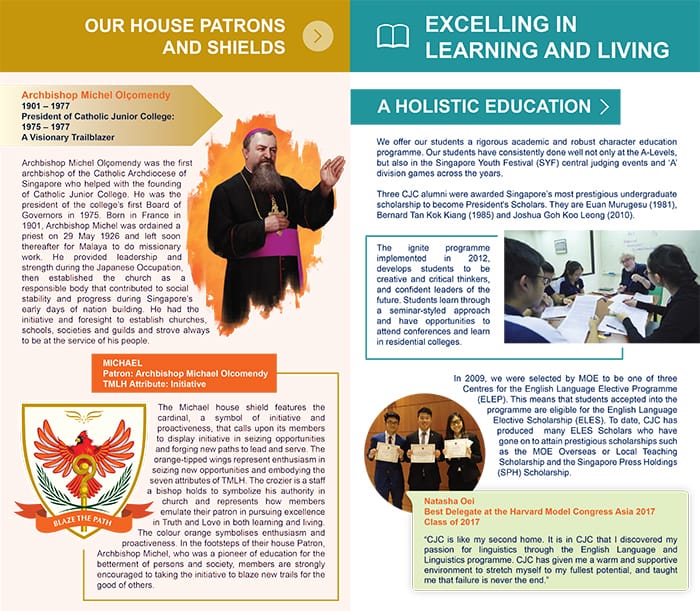
The CJC Ignite Talent Development Programme nurtures students to become thinkers, leaders and changemakers by providing opportunities to stretch academically, grow in leadership, and apply learning beyond the classroom.
Students may apply for selection to our Ignite classes, which challenge them intellectually, develop critical and creative thinking and build confidence. They gain access to university seminars, national forums, industry attachments and competitions, collaborating with like-minded peers to broaden their horizons.
Students who demonstrate consistent academic performance and leadership potential may be selected for our Ignite+ programme, focusing on community leadership. Through mentoring, grassroots involvement and service-learning opportunities, students grow in empathy, self-awareness and purpose, learn to lead with humility, and create meaningful social impact while connecting with teacher-mentors and alumni for guidance and inspiration.
The Ignite talent development programme equips students with the knowledge, skills and mindset to excel academically, lead with purpose, and contribute meaningfully to the community.
Knowledge Skills
These subjects are designed to support a rigorous course of academic study by developing higher order thinking skills, conceptual thinking, processing skills and communication skills.
General Paper – This subject develops in students the ability to think critically, explore a range of key issues of global and local significance and express their views in cogent arguments using accurate and effective language. It comprises two main modes of assessment (writing and reading comprehension) to ensure that students are familiar with the skills required to write an academic argument and to evaluate and assess academic writing. The course spans the complete two years of the junior college course.
Project Work – Students work in groups of 4-5 on a real-world research project, completing a Project Summary, Individual Reflection, and oral presentation in JC1. Graded Pass/Fail from 2024, students are mentored to apply their ideas through service-learning, developing critical thinking, communication, collaboration and creating positive social impact.
Ministry of Education (MOE) Special Programmes at CJC
English Language and Linguistics
English Language and Linguistics (ELL) is a subject offered at the H2 level. This subject has been offered as a national A-Level curriculum since 2009. ELL provides students with an excellent grounding in the intricacies of the English language and includes features of disciplines such as Linguistics, Psycholinguistics and Sociolinguistics.
CJC is one of the three schools offering the English Language Elective Programme (ELEP) in Singapore. This allows selected students with high aptitude for the subject to receive bond-free scholarships that include remission of school fees and an annual allowance.
Local and Overseas Academic Learning Programme and Trips
CJC offers students a rich learning programme which enables engaged and authentic learning experiences. Besides classroom learning, students embark on a range of exciting learning activities, competitions, talent development and research programmes. These also include overseas academic trips to Vietnam, Hong Kong and Japan in partnership with reputable organisations and Institutes of Higher Learning.

Financial Information
Please click here (opens in new tab) to view the latest information.